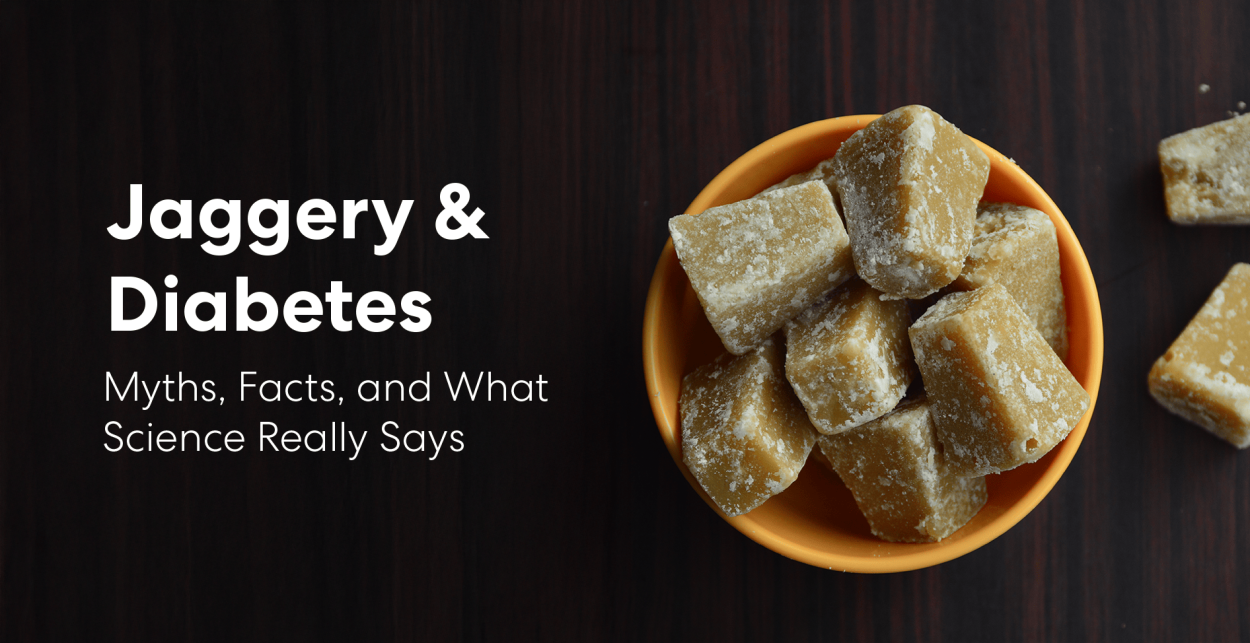
Jaggery (gur) is often promoted as a “natural” and “healthier” alternative to white sugar. Many people with diabetes believe switching from sugar to jaggery makes sweets safer. But is that true? Let’s break down the science, myths, and facts behind jaggery and diabetes.
What Is Jaggery?
Jaggery is an unrefined sweetener made from sugarcane juice or palm sap. Unlike refined sugar, it retains small amounts of minerals such as iron, calcium, potassium, and magnesium. Because it undergoes minimal processing, it is often perceived as more “natural.”
But natural does not automatically mean diabetes-friendly.
Myths & Facts around Jaggery and Diabetes
Myth 1: Jaggery Is Safe for Diabetes Because It Is Natural
This is the most common misconception.
Although jaggery contains trace minerals, it is still primarily sucrose (about 65–85%), along with glucose and fructose. Its carbohydrate composition is very similar to table sugar.
Fact: Jaggery raises blood glucose levels almost as much as white sugar.
People with diabetes must monitor total carbohydrate intake—not just whether the source is “natural.”
Myth 2: Jaggery Has a Low Glycemic Index
Many online sources claim jaggery has a lower glycemic index (GI) than sugar. However, available evidence suggests its GI is moderate to high, meaning it can cause a rapid rise in blood glucose.
There is no strong clinical evidence showing jaggery provides superior glycemic control compared to refined sugar.
Myth 3: Jaggery Helps in Weight Loss
Some believe jaggery boosts metabolism or helps “cleanse” the body. Scientifically, jaggery contains nearly the same calories as sugar (~4 kcal per gram). Excess intake can contribute to weight gain, which worsens insulin resistance.
Fact 1: Jaggery Contains Small Amounts of Micronutrients
Compared to refined sugar, jaggery retains:
- Iron
- Calcium
- Magnesium
- Potassium
- Antioxidant compounds
However, the quantities are small and not sufficient to justify unrestricted use in diabetes.
You would need to consume large amounts to meet significant nutrient requirements—doing so would spike blood glucose.
What About Jaggery in Baked Products?
A study by Lamdande et al. (2018) evaluated replacing sugar with jaggery in muffins. The research showed that jaggery affected texture, sensory quality, and storage properties, making products slightly denser and darker.
While jaggery can enhance flavor and mineral content in baked goods, the study did not show it makes products suitable for diabetes management.
In short: A jaggery muffin is still a high-carbohydrate food.
What Do Recent Reviews Suggest?
Recent food science research (2022–2025) indicates that jaggery may contain bioactive compounds and antioxidants due to minimal refining. However:
- Its carbohydrate load remains high.
- It still impacts blood glucose significantly.
- It should be treated as a sugar substitute—not a diabetes therapy.
There is no strong clinical evidence supporting jaggery as a safe sweetener for uncontrolled diabetes.
Sugar vs Jaggery: Quick Comparison
| Feature | White Sugar | Jaggery |
|---|---|---|
| Processing | Highly refined | Minimally refined |
| Minerals | Negligible | Small amounts |
| Calories | ~4 kcal/g | ~4 kcal/g |
| Effect on Blood Sugar | High | High |
| Suitable for Diabetes? | Limited use only | Limited use only |
So, Is Jaggery Suitable for Diabetes??? Short answer: Not really.
Jaggery is slightly more nutrient-dense than sugar, but it still significantly raises blood glucose levels. People with diabetes can consume it only in very small quantities, within their carbohydrate allowance, and preferably alongside fiber or protein to slow glucose absorption.
For better glycemic control, consider:
- Stevia
- Monk fruit extract
- Erythritol
- Controlled portions of natural fruit sweetness
When Jaggery Be Can Used?
✔ In very small amounts
✔ As part of a balanced meal (not on an empty stomach)
✔ When blood sugar levels are well controlled
✔ Under guidance of a dietitian
Who Should Avoid or Strictly Limit It?
- Individuals with uncontrolled diabetes
- Those with high HbA1c
- People trying to reduce carbohydrate intake
- Individuals with obesity and insulin resistance
Final Verdict
Jaggery is less processed but not low in sugar. It may offer minor nutritional advantages over refined sugar, but it is not a diabetes-friendly sweetener. The belief that jaggery is safe for diabetics is largely a myth.
Moderation, portion control, and total carbohydrate monitoring remain the key principles in diabetes management.Jaggery may be less processed than refined sugar, but it still contains a high amount of carbohydrates and can raise blood sugar levels significantly. While it provides small amounts of minerals, these benefits are not enough to make it a safe sweetener for people with diabetes.
For individuals managing diabetes, the key is moderation, portion control and regular monitoring of blood glucose levels. Instead of relying on “natural” sweeteners like jaggery, it is better to focus on balanced meals, fiber-rich foods, and evidence-based dietary guidance.
If you have diabetes or are at risk of developing it, personalized medical advice can make a big difference. Platforms like Even Healthcare provide access to doctors, preventive care, and health guidance that can help you better manage blood sugar and overall health. If specialized consultation or diagnostic evaluation is needed, you can also visit Even Hospitals for comprehensive medical care.
Making informed choices and seeking the right medical support can help you manage diabetes more effectively and maintain long-term health.
References
- Lamdande AG, Khabeer ST, Kulathooran R, Dasappa I. Effect of replacement of sugar with jaggery on pasting properties of wheat flour, physico-sensory and storage characteristics of muffins. J Food Sci Technol. 2018;55(8):3144-3153. doi:10.1007/s13197-018-3242-7