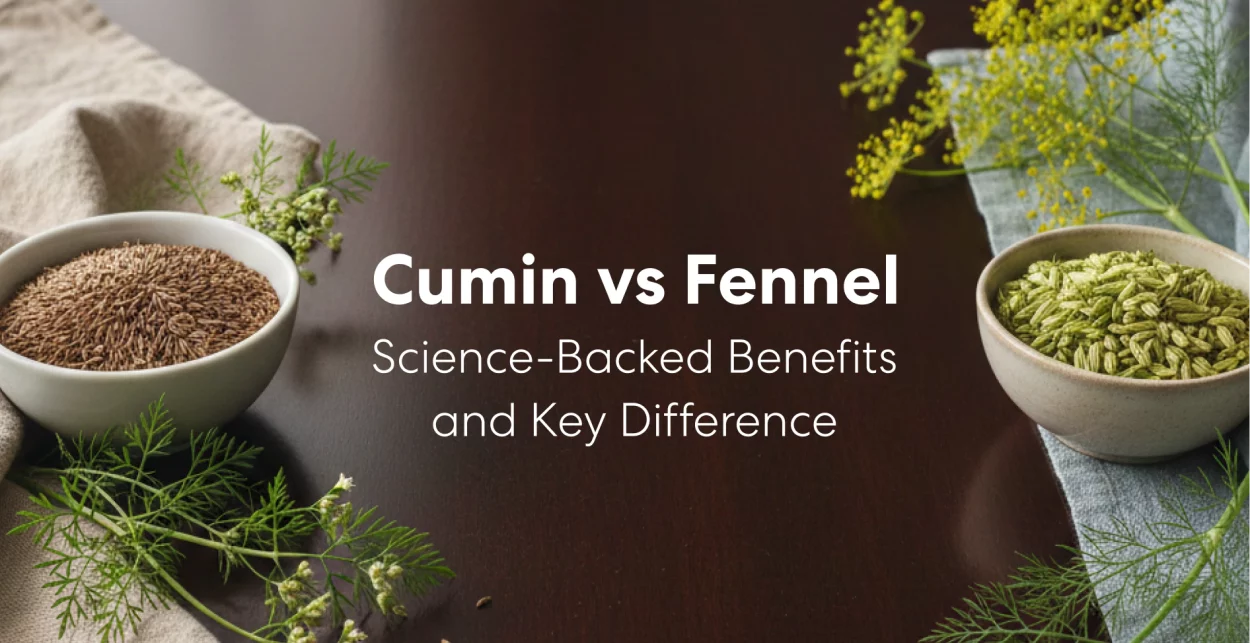
Cumin (Cuminum cyminum) and fennel (Foeniculum vulgare) are two of the most valued spices across traditional and modern medicine. Their uses extend far beyond culinary flavor—they offer antioxidant activity, antimicrobial effects, and therapeutic value supported by contemporary research. Multiple studies have compared their phytochemical composition, biological actions, and regional variations, providing a comprehensive understanding of how these seeds contribute to human health (Comparative Study on Antioxidant Potential, 2014; Yang et al., 2021; Malik et al., 2019; Allaithy, 2017; Korinek et al., 2021).
Phytochemicals and Antioxidant Potential
Both cumin and fennel contain rich phytochemicals volatile oils, flavonoids, and phenolic compounds that underpin their antioxidant activity. A comparative phytochemical analysis revealed that fennel seeds are abundant in anethole, estragole, and fenchone, which contribute to their sweet aroma and antioxidant strength. Cumin, in contrast, contains high levels of cuminaldehyde and various terpenes, giving it a stronger, earthy profile with notable antioxidant capacity (Comparative Study on Antioxidant Potential, 2014). These differences highlight how each spice offers unique phytochemical advantages while both contribute significantly to oxidative stress reduction.
Regional Identification Through Advanced Technology
New research utilizing generative adversarial networks (GANs) combined with near-infrared spectroscopy has shown that cumin and fennel can be accurately identified based on their regional chemical signatures (Yang et al., 2021). This demonstrates that environmental conditions and cultivation areas affect the phytochemical composition of the seeds. Such advancements help ensure authenticity, quality control, and traceability in the spice industry.
Antimicrobial Properties
Cumin and fennel seeds show strong antimicrobial potential in laboratory studies. Research examining seed extracts found that both spices inhibited several pathogenic bacterial strains, validating their traditional use in combating infections and preserving foods (Allaithy, 2017). Their volatile oils also demonstrate antimicrobial activity, suggesting they may contribute to natural preservation and complementary infection management strategies (Korinek et al., 2021). These findings, however, are preliminary and do not replace medical treatment.
Anti-Inflammatory Effects
One of the most significant findings comes from research on the anti-inflammatory properties of volatile oils. A 2021 study confirmed that both fennel and cumin volatile oils suppress neutrophilic inflammation by modulating calcium signalling and MAPK pathways, which play a central role in immune activation and acute inflammatory responses (Korinek et al., 2021). This mechanistic evidence supports their traditional use for managing inflammatory conditions, although clinical trials are needed to establish therapeutic doses.
Therapeutic and Nutritional Value
A broad review of spice-based nutrition highlighted the wide-ranging therapeutic benefits of cumin and fennel. These include digestive support, relief from bloating, antioxidant contributions, hormonal balancing (particularly fennel’s phytoestrogenic effects), and enhancement of nutrient absorption (Malik et al., 2019). Both spices are nutrient-dense, offering trace minerals and dietary fiber, making them valuable daily dietary additions in small culinary quantities.
Practical Health Benefits: Cumin vs Fennel
While both spices offer valuable health effects, their benefits differ slightly in practice. Fennel is particularly effective as a gentle digestive aid, often consumed after meals as a tea or mouth freshener. Its soothing phytochemicals help reduce gas, cramps, and mild indigestion. Cumin, on the other hand, is well known for its stronger digestive stimulation and warm flavor profile that enhances nutrient absorption and metabolic activity when added to cooked dishes. Both show anti-inflammatory and antimicrobial potential, making them useful additions to overall wellness routines.
Myths vs Facts around Cumin vs fennel benefits
❌ Myth 1: “Cumin or fennel can replace antibiotics.”
Fact: Lab studies show antimicrobial activity, but they cannot replace prescribed antibiotics
(Allaithy, 2017; Korinek et al., 2021).
❌ Myth 2: “Fennel is unsafe because it acts like estrogen.”
Fact: Fennel contains mild phytoestrogens. Culinary amounts and teas are generally safe, but high-dose extracts should be used with caution
(Malik et al., 2019).
❌ Myth 3: “Cumin burns fat and causes fast weight loss.”
Fact: Cumin may support metabolism modestly, but it is not a fat-burning miracle spice.
❌ Myth 4: “These spices have no side effects.”
Fact: In high doses, volatile oils can cause:
- gastric irritation
- allergic reactions
- hormonal interactions (fennel)
Conclusion around Cumin vs fennel benefits
Even Hospital and its Clinical Nutrition Department play a crucial role in helping individuals use spices like cumin and fennel in safe, effective, and science-backed ways. Through personalized nutrition counselling, medically supervised diet strategies, and symptom-focused guidance, the dietitians at Even Hospital help patients understand how these spices can support digestion, reduce bloating, and enhance overall wellness. By integrating evidence-based nutrition with compassionate care, Even Hospital empowers individuals to make informed decisions about traditional spices and use them wisely as part of a balanced, health-supporting lifestyle.
Reference
Comparative Study on Antioxidant Potential and Phytochemical Composition of Cumin and Fennel. (2014). Journal of Herbs, Spices & Medicinal Plants, 20(3). https://doi.org/10.1080/10496475.2013.861379
Yang, B., Chen, C., Chen, F., Chen, C., Tang, J., Gao, R., & Lv, X. (2021). Identification of cumin and fennel from different regions based on generative adversarial networks and near infrared spectroscopy. Spectrochimica Acta Part A: Molecular and Biomolecular Spectroscopy. https://doi.org/10.1016/j.saa.2021.119956
Malik, S., Amin, R., Ansari, S. B., Jahan, R., & Khan, S. (2019). A review on the therapeutic and nutritional value of spices and their prospects. International Research Journal of Pharmacy. https://doi.org/10.7897/2230-8407.101131
Allaithy, S. A. M. (2017). Chemical compound of cumin and fennel seed extracts against some types of pathogenic bacteria. Iraq Medical Journal, 1(1), 1–6.
Korinek, M., Handoussa, H., Tsai, Y.-H., Chen, Y.-Y., Chen, M.-H., Chiou, Z.-W., Fang, Y., Chang, F.-R., Yen, C.-H., Hsieh, C.-F., Chen, B.-H., El-Shazly, M., & Hwang, T.-L. (2021). Anti-inflammatory and antimicrobial volatile oils: Fennel and cumin inhibit neutrophilic inflammation via regulating calcium and MAPKs. Frontiers in Pharmacology, 12, 674095. https://doi.org/10.3389/fphar.2021.674095