

Yes – a mandatory health check-up for employees over 40 is now the law in India. Under the new Labour Codes, every employer must provide a free annual health check-up to all workers above the age of 40, fully funded by the company. This guide explains exactly what the rule requires, who is covered, what the check-up should include, and how employers can comply.
Last updated: 9 June 2026 · Reviewed by the Even editorial team
Key Takeaways
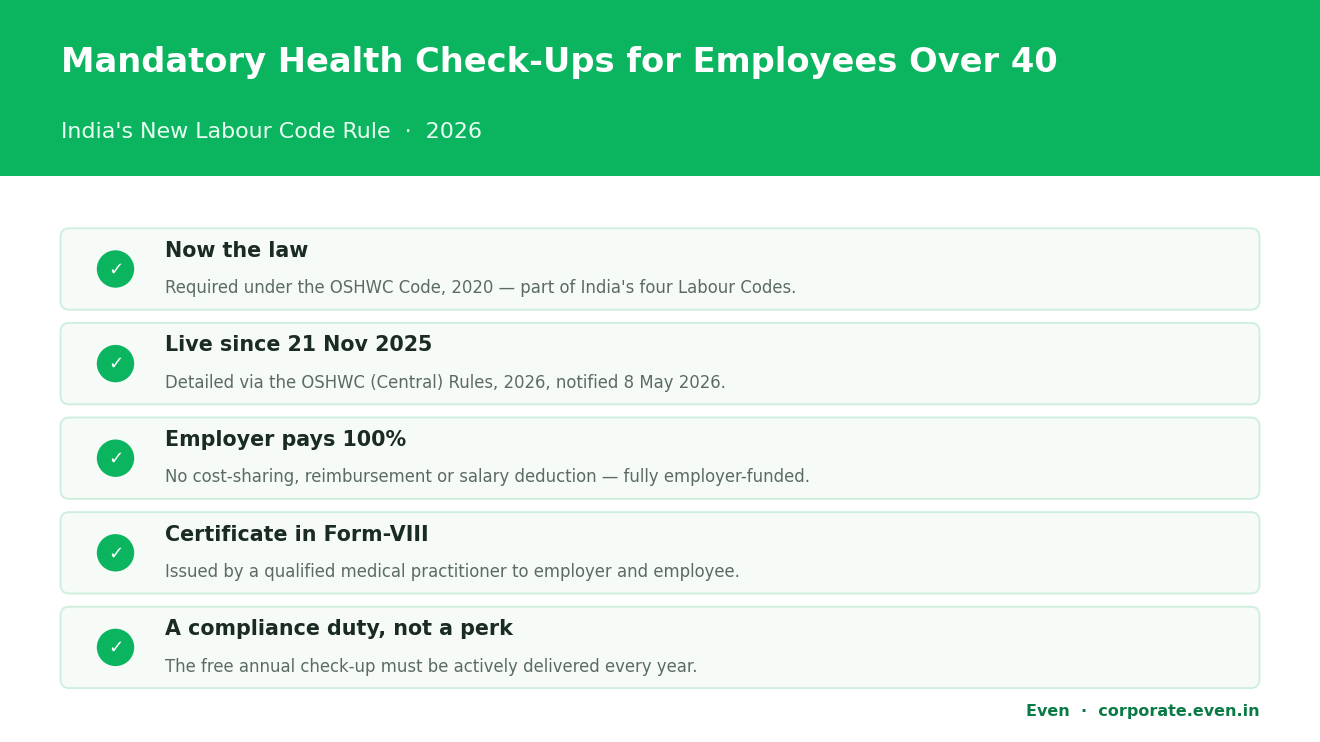
- It is now the law. Under India’s Occupational Safety, Health and Working Conditions (OSHWC) Code, 2020, employers must give every worker above the age of 40 a free annual health check-up.
- Live since 21 November 2025. All four Labour Codes came into force on that date, and the supporting OSHWC (Central) Rules, 2026 were notified on 8 May 2026.
- The employer pays 100%. There is no cost-sharing, reimbursement, or salary deduction model – the check-up must be provided entirely at the employer’s expense.
- A certificate is required. A qualified medical practitioner conducts the examination and issues a certificate in Form-VIII to both the employer and the employee.
- It is a compliance duty, not a perk. The benefit must be actively delivered – listing it in a benefits brochure is not enough.
Short Summary
India’s new Labour Codes make an annual health check-up mandatory for all employees over 40, fully funded by the employer. The rule is anchored in the OSHWC Code, 2020 and operationalised through the OSHWC (Central) Rules, 2026. For employers, this turns preventive screening from an optional wellness add-on into a statutory obligation – and, done well, into a measurable return on human capital through lower absenteeism, higher retention, and earlier detection of non-communicable diseases (NCDs) such as diabetes, hypertension, and heart disease. This guide explains what the rule says, who is covered, what a 40+ check-up should include, how to comply step by step, and the mistakes to avoid.
Is a mandatory health check-up for employees over 40 required by law?
Yes. As of 21 November 2025, Indian employers are legally required to provide a free annual health check-up to every worker above the age of 40. The requirement sits within the Occupational Safety, Health and Working Conditions (OSHWC) Code, 2020 – one of the four Labour Codes that together replace 29 older labour laws. The detailed procedure was finalised when the Ministry of Labour and Employment notified the OSHWC (Central) Rules, 2026 on 8 May 2026.
In plain terms: if you employ people aged 40 and above, an annual medical examination is no longer a goodwill gesture. It is a documented compliance requirement, paid for by you, with a certificate issued for every eligible employee.
Why 40 is the threshold: the rise of “silent killer” diseases
Crossing 40 marks a biological shift where the risk of non-communicable diseases (NCDs) climbs sharply. These conditions are called “silent killers” because they often show no clear symptoms until they are advanced. An annual check-up establishes a health baseline and surfaces hidden threats while treatment is still simple and effective.
The risk is especially acute in India. Indians tend to develop cardiovascular disease around a decade earlier than Western populations – a pattern Even’s doctors have written about in Young and Heartbroken: Indians Experiencing Heart Attacks 10 Years Earlier Than the West. Type 2 diabetes is similarly widespread; our team answers the most common patient questions in 10 Most Googled Questions About Type 2 Diabetes.
Conditions most often caught through 40+ screening include:
- Silent cardiovascular risks: elevated blood pressure and abnormal lipid (cholesterol) profiles, before they trigger a cardiac event. Diet plays a role here too – see our note on heart, cholesterol and metabolic health.
- Early diabetes indicators: pre-diabetes or Type 2 diabetes, where early lifestyle changes can manage or even reverse the condition. Learn the basics in Diabetes: What You Need to Know.
- Organ function decline: liver and kidney function tests that reveal damage from years of stress and lifestyle.
- Age-specific cancers: timely screening for cancers whose incidence rises with age – for example breast cancer and testicular cancer, both highly treatable when caught early.
Who is covered under the mandate?
The obligation applies broadly across employment types. The OSHWC (Central) Rules, 2026 specifically call out dock work and building or other construction work, plus other classes of establishment as notified by the Central Government – while the wider Code framework extends preventive-care expectations across industries.
| Question | Answer |
|---|---|
| Which age group? | All workers above 40 years of age |
| Which employment types? | Permanent, contract, fixed-term and MSME workers |
| Who pays? | The employer, in full – no cost-sharing |
| How often? | Once every year (annual) |
| What proof is needed? | A certificate in Form-VIII for each eligible employee |
| Who conducts it? | A qualified medical practitioner |
What should a 40+ annual health check-up include?
While exact panels vary by provider and by hazardous-work category, a meaningful 40+ screening for office and general workforces typically covers the markers most likely to catch NCDs early:
| Category | Typical tests | What it screens for |
|---|---|---|
| Cardiometabolic | Blood pressure, lipid profile, fasting glucose / HbA1c | Hypertension, high cholesterol, diabetes |
| Organ function | Liver function test (LFT), kidney function test (KFT) | Liver and kidney damage |
| Blood health | Complete blood count (CBC), thyroid (TSH) | Anaemia, infection, thyroid disorders |
| Cancer screening | Age- and gender-appropriate screens | Early-stage, treatable cancers |
| Vitals & BMI | Height, weight, BMI, waist circumference | Obesity and metabolic risk |
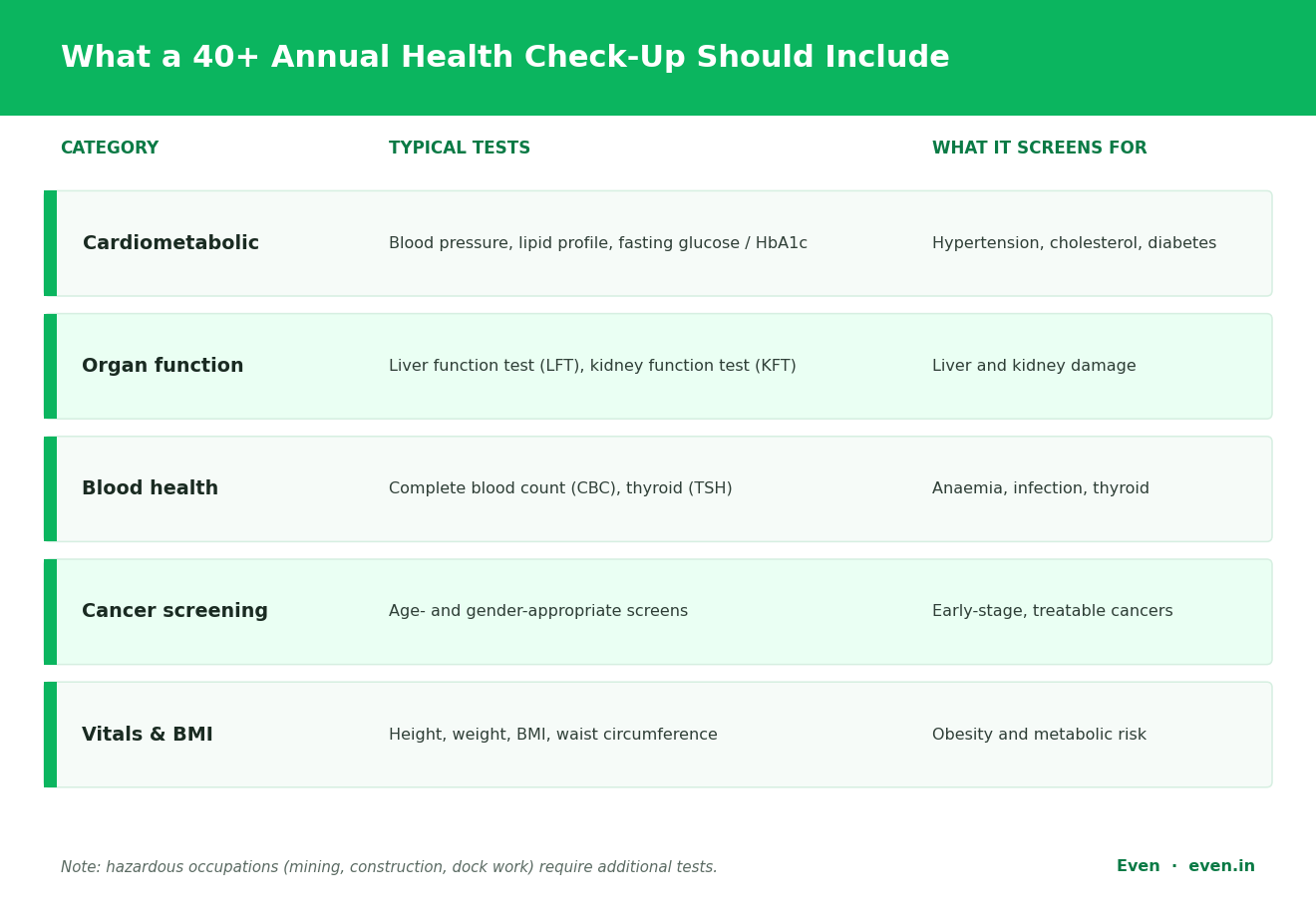
Note: Mine workers and certain hazardous occupations require additional tests and conditions under the Rules. Confirm the exact panel with your medical provider for your industry.
How employers can comply: a step-by-step checklist
- Identify eligible employees. Pull a list of every worker aged 40 and above across all locations and employment types.
- Choose a qualified provider. Partner with a medical provider or B2B health platform that can run examinations through a qualified medical practitioner.
- Define the test panel. Set a baseline 40+ panel (cardiometabolic, organ function, cancer screening) and add industry-specific tests where required.
- Schedule with minimal disruption. Use on-site camps or scheduled clinic slots so productivity isn’t affected.
- Collect Form-VIII certificates. Ensure each eligible employee – and your records – receives the certificate.
- Protect confidentiality. Deliver results directly and privately to each employee; the employer receives compliance confirmation, not clinical details.
- Repeat annually. Calendar the programme so it runs every year without lapse.
The business case: compliance as a return on investment
For organisations, meeting this mandate delivers far more than regulatory peace of mind. Preventive screening is one of the highest-ROI investments in human capital available to an employer:
- Reduced absenteeism: early disease management cuts down extended medical leave.
- Higher productivity: employees who are well and managing their health are more focused, reducing “presenteeism.”
- Better retention and morale: a genuine health benefit signals that the company values its most experienced talent.
- Lower long-term claims: catching conditions early reduces costly late-stage treatment and insurance claims over time.
Common mistakes to avoid (and best practices)
| Common mistake | Best practice |
|---|---|
| Listing the check-up as a “benefit” but never delivering it | Actively schedule and run the examination every year |
| Asking employees to pay and reimburse later | Fund it 100% upfront – no cost-sharing is permitted |
| Skipping documentation | Collect and store the Form-VIII certificate for each employee |
| Using a generic panel for hazardous roles | Add industry-specific tests for mining, construction and dock work |
| Sharing clinical results with managers | Keep results confidential to the employee; share only compliance status |
| Running it once and forgetting | Set an annual recurring programme across all locations |
Explore more preventive-health guidance in our Health section, including Thriving After 50: A Quick Guide to Women’s Health and why your sleep isn’t as restful as it used to be.
Frequently Asked Questions
The Occupational Safety, Health and Working Conditions (OSHWC) Code, 2020, supported by the OSHWC (Central) Rules, 2026. It is one of the four Labour Codes that came into force on 21 November 2025.
The employer pays the full cost. There is no cost-sharing, reimbursement or salary deduction model – the check-up must be provided entirely at the employer’s expense.
The four Labour Codes became effective on 21 November 2025. The detailed OSHWC (Central) Rules, 2026, which set out the procedure, were notified and came into force on 8 May 2026.
Form-VIII is the medical examination certificate issued by a qualified medical practitioner after the check-up. A copy is given to both the employer and the employee as proof of compliance.
All workers above 40 – permanent, contract, fixed-term and MSME – are covered. The Rules specifically name dock work and building or other construction work, with additional classes of establishment to be notified by the Central Government.
Panels vary, but a meaningful 40+ screening usually covers blood pressure, lipid profile, blood sugar (fasting glucose or HbA1c), liver and kidney function, a complete blood count, thyroid, BMI, and age-appropriate cancer screening. Hazardous occupations require additional tests.
Partner with a B2B health provider that operates pan-India, such as Even for Business (corporate.even.in), which coordinates on-site camps and clinic appointments, handles Form-VIII documentation, and delivers confidential results – minimising disruption across locations.
Putting the mandate into practice
Building preventive care into your routine is easier with the right support: health insurance with OPD cover for ongoing consultations and diagnostics, plus in-person treatment at Even Hospital, a multispecialty hospital in Bangalore.
Related reading
- Why Indians have heart attacks 10 years earlier
- Diabetes: what you need to know
- Cough, cold and fever: when to see a doctor
- Free online doctor consultation
- More from the Even Health blog
References
- Press Information Bureau, Government of India – Mandatory annual health check-up for workers above 40 (PRID 2192463).
- Ministry of Labour and Employment – Occupational Safety, Health and Working Conditions (Central) Rules, 2026 (notified 8 May 2026).
- Occupational Safety, Health and Working Conditions Code, 2020 – one of India’s four Labour Codes, effective 21 November 2025.